Wednesday, June 20, 2018

A light in the dark - The bioluminescent bay in Vieques

To this day it remains the most beautiful thing I have ever seen. While seen at greatest brilliance in the pitch black of a night with a new moon, there was a sliver of silver the evening I first saw Puerto Mosquito at night. Named for the insects that are prevalent alongs the banks of the small bay, this little body of water looks unassuming and muddy in the daylight. At night, however, when the water is moved by a boat, by a paddle, by your hand, or by fish and manta rays swimming beneath you, the water glows a brilliant emerald green, illuminating the darkness around you. In an instant you feel like somehow, when you weren't paying attention, you must have left Earth behind.
The star of the show, Pyrodinium bahamense. Wikimedia Commons
The glowing is due to a dinoflagellate called Pyrodinium bahamense. This is a tiny, one-celled creature that has two long, whiplike tales coming out of its body that flip around to move it through the water. This dinoflagellate has a unique beauty to it. When P. bahamense are disturbed, they glow, a process called bioluminescence. It's only for a fraction of a second, but when there are many of them, their agitated glow is profoundly beautiful. While these small cells are many places, few places are they as dense in the water as Vieques, Puerto Rico, where their vast numbers fuel both the local economy and the excitement of those lucky enough to make it to Vieques. Not only is this bioluminescent bay beautiful, but it is one of the brightest and most pristine in the world. You can see it for yourself in the video below.


Yet the balance of this bay is delicate. These plankton need a very particular environment to live in. If the water changes in the slightest, if it gets polluted, if the trees lining the bay disappear, or even if the wind changes, the system can be thrown. The magic could stop, and the bay might go dark. It has before.

On the last night I was in Vieques, the bay stopped glowing. It remained dark for months, worrying locals who rely on the bay for their livelihood and those who have already fallen in love with its eerie glow. The sudden darkness was a mystery, one that still isn't fully understood. Ultimately Puerto Mosquito began to glow again, but when Hurricane Maria hit, the brightness of the bay was hit once again, leaving the glowing water merely flickering. Once again it has made a slow recovery, and the glow has begun to return. These events though, paired with the permanent blackouts of other bioluminescent bays, only highlight how important it is to understand these delicate systems. If the bay is to continue to glow, the people of Vieques must understand what is going on.
Me at work on the bay in January 2014

The Vieques Conservation and Historic Trust (VCHT) is a local non-profit organization dedicated to the bay and to the surrounding community. It is the one that took me, a shy college student who had never been anywhere, and helped instill in me a passion for the natural world. They lead community meetings, monitor the bay, teach local children about the beauties of the island around them, and have helped rebuild this tiny island after Hurricane Maria. The people there are warm, hardworking, inviting, and passionate. They care deeply about the island around them and also about showing others the wonders of their small community. They have worked hard to rebuild after Maria, but while physical structures can be refortified, labs and equipment are harder.

Months after Maria hit, they still don't have a fully functional lab to continue the important work they do every day, monitoring Puerto Mosquito. They are trying to get it back up and running, but they need our help. If you make a donation (make sure to comment that is is for the lab), you are helping the people of Vieques to understand how best to protect the heart of their community. On an island where there is little industry and the economy revolves around tourism, protecting the bay is not only a scientific priority but a community priority. While the world can feel like it is spinning out of control, this is one small, concrete step you can take that will have an impact on the people in Vieques. And sometimes it's nice to protect some of the world's magic.

Thursday, April 19, 2018

Jelly blooms - Will you be eating jellyfish burgers in the future?

No brain, delicate enough to be killed by a bubble, bad swimmers, and... taking over the ocean? Jellyfish, on the surface, may seem like an unlikely set of creatures to be concerned about. Yet in recent years, jellyfish have become a huge problem in certain parts of the world, clogging fishing nets, shutting down power plants, and stinging vacations swimmers. While there isn't solid proof that the number of jellyfish is increasing globally, there has been a dramatic increase in specific regions, leading to concern that the future of the oceans may be gelatinous.
Cnidarians - Wikimedia Commons

Jellyfish fall into two separate groups: cnidarians and ctenophores. Both groups have bodies that are gelatinous, are generally poor swimmers, and filter feed. The largest difference between the two groups is that cnidarians have long tentacles with stinging cells. These are the ones you want to avoid when swimming. Ctenophores, also known as comb jellies, are harmless and can't sting. 

Ctenophors, or comb jellies - Wikimedia Commons
But why are animals that can't swim and that have such delicate bodies doing so well when so many species seem to be struggling? It's because jellyfish are what we call generalists, organisms that can live in a variety of places and eat a variety of food sources. Jellyfish do well when other species have trouble. Many species need just the right combination of temperature, oxygen, light, and even salt in the water, but jellyfish are resilient to these changes. We are also giving jellyfish a leg up. Humans frequently fish for species that eat baby jellyfish, meaning more baby jellies survive. Finally, with seawater getting warmer, jellyfish reproduce faster. In general, when humans throw a coastal ecosystem out of whack, jellyfish are the ones to remain, and not just remain but thrive. 

These jellyfish can be a menace of the seas for a number of reasons:
  1. They cause emergency shut downs in power plants, even nuclear ones. A lot of these power plants take in seawater to cool off the machinery. When the water is too full of jellyfish, it clogs up the entire plant, putting it in danger of overheating and making it necessary to close the plant until the jellyfish can be removed.. This can cause power outages in the region and ultimately costs a lot of money.
  2. Jellyfish wreak havoc on fishers. They clog up the nets, sometimes so densely that the nets will break, and even sank a 10-ton fishing trawler in Japan. Jellyfish also eat baby fish, meaning that once there is a huge bloom of jellies, fewer fish make it to adulthood. Even if the nets of the fishers weren't entirely clogged with jellyfish, at this point there would be fewer fish to catch.
  3. Jellyfish can get in the way of tourism. Nobody wants to go swimming in waters where they are likely to get stung.
  4. A large presence of jellyfish can actually suffocate other animals. Jellyfish need less oxygen in the water than most species of fish. However, when jellyfish die, especially en masse, their bodies are decomposed by bacteria, which use up the oxygen that is in the water. This leaves little for fish to breathe, making water inhospitable for animals besides jellyfish and bacteria.
Massive blooms of giant jellyfish used to be rare. According to Shin-Ichi Uye, in Japan, where blooms of giant jellyfish have brought global attention, there used to be a massive bloom of jellyfish every 40 years. In the early 2000s, however, a massive bloom happened in 2002, 2003, 2005, 2006, and 2007. This particular species of jellyfish, Nemopilema nomurai, is massive: they can grow to be 6 feet wide and weigh over 440 pounds each! The fishing industry struggled as a result. In 2005 alone, fishers filed 100,000 complaints about the jellyfish. What did they think the cause was? Japan blamed it on water running into the ocean from China, bringing nutrients used for farming into the water. This could cause algae blooms and low oxygen conditions that jellyfish thrive in while other species suffer. Luckily for Japan, there haven't been huge blooms of jellyfish in recent years, but the experience was enough to leave people nervous.

Japan isn't the only place to see an uptick in jellyfish blooms. There have been problems in the Black Sea, in the Mediterranean Sea, and in many east Asian waters. Most of the places that have the most trouble with jellyfish blooms are the ones where there is the most human impact, meaning humans fish more there, there is more nutrients in the water from farming, there is more construction, and there are more non-native species that are brought to these waters, often the offending jellyfish themselves. But are jellyfish increasing globally? If waters get warmer, have less oxygen, and become more acidic, all things that we see happening, doesn't that set the stage for an ocean dominated by jellyfish?

Jellyfish and roast duck salad
Wikimedia Commons: Credit Line
Maybe. The problem is that jellyfish populations tend to fluctuate over the span of many decades. If the number of jellyfish fluctuate in a pattern every 40 or 50 years, you need a record of jellyfish that is at least 40 or 50 years long to say anything definitively, and in most cases we just don't have that. But with all the changes we see happening to the ocean, it is entirely possible that we will see more frequent, larger blooms in many areas.

So what can we do besides reduce pollution and do what we can to slow climate change? The answer may sound familiar; it is often a proposed solution when an animal takes over an ecosystem. We could eat them. In fact, in order to tackle a troublesome surplus of jellyfish in the Mediterranean Sea, there has been an effort to get Europeans to eat jellyfish. Chinese and Japanese cultures already embrace eating jellyfish. If life gives you lemons, make lemonade; if the ocean gives you jellyfish, make jellyfish burgers.


Wednesday, March 28, 2018

Science News - How hogfish see with their skin

There are a number of animals in the ocean that can flash colors right before your very eyes. When threatened, a common cuttlefish may get a black stripe, like a masked bandit, over its eyes as its tentacles flair angrily. An octopus will change its color and texture to match its surroundings, making it practically invisible in the landscape. 

How do these animals know when to change color? Are they expertly taking in their surroundings with their eyes, or is there something else at work? In an effort to get to the bottom of this phenomenon, researchers Schweikert, Fitak, and Johnsen from Duke University in Durham, North Carolina have decided to take a look at another one of nature's magicians, the hogfish.

Taken by Albert Kok - Wikimedia Commons
Hogfish are brilliantly colored reef fish famous for their mating behaviors. All hogfish are born female, but after a female matures and reaches a certain level of social dominance, the female changes her sex and becomes a male. While hogfish live in groups, there is only one male, guarding his own personal harem. If something should happen to him, a dominant female will rise up, change sexes, and replace him. 

Hogfish are just as adept at changing their color as they are at changing their sex, shown below in a video uploaded by Mark Karl in 2014.


The key to these changes lie in pigmented skin cells called chromatophores. Chromatophores rapidly rearranged pigments in the skin to change the color, morphing the appearance of either a small area on the animal or even the entire animal itself. However, scientists are still trying to figure out what tells chromatophores to change color. Rather than the hogfish seeing with their eyes, researchers believe hogfish are, in a sense, seeing with their skin, a process called dermal photoreception.

To test out this theory, the researchers at Duke University looked at the genes hogfish have in both their skin and in their eyes. Examining genes is one of the best ways to look at what is happening throughout the body because they serve as the blueprint for proteins in the cells. Proteins are essentially the workers of each cell, so by looking at genes, the researchers were looking at the job descriptions of proteins in the eyes and skin of hogfish. After these proteins do their job, however, the rest of the workers in the cell need to know what to do. Messages can be spread through the cell by other proteins in a signal pathway, a phenomenon similar to a game of telephone. Scientists can also see the code for this kind of communication in the genes. Essentially, the scientist looked at the job description of various workers in each cell as well as how these workers communicate to describe what was going on. 


Photo by Bernard Dupont - Wikimedia Commons

What the researchers found is that hogfish can see with their skin, although not in the same way they can see with their eyes. Hogfish have a protein in their skin called SWS1 that can sense ultraviolet light; in contrast, hogfish eyes have five separate proteins that can be used to see. In addition, the signal pathway that SWS1 uses to communicate, called cAMP, is different from the signal pathway used by the proteins in the eyes, or cGMP. This means that while hogfish use both their eyes and their skin to see, the eyes and the skin don't have the same proteins, and these proteins don't communicate in the same way. While both the eyes and the skin of hogfish can be used to sense the light around them, both parts of the body are doing it in a completely different way.

This discovery is groundbreaking; it is the first time that scientists have been able to show that color-changing fish can sense visual signal, light, with something other than their eyes. There is a lot more work to be done to figure out how much the color of the fish is impacted by the eyes versus the skin and how this factors into how other animals change color. Still, this is an exciting first step in exploring one of nature's coolest phenomenon.


Article Citation:
Lorian E. Schweikert, Robert R. Fitak, Sönke Johnsen. 
De novo transcriptomics reveal distinct phototransduction signaling components in the retina and skin of a color-changing vertebrate, the hogfish (Lachnolaimus maximus). Journal of Comparative Physiology A, 2018; DOI: 10.1007/s00359-018-1254-4

Tuesday, March 20, 2018

Blue-bloods in America - How horseshoe crabs can save your life


The horseshoe crab looks menacing. Its dark body crawls along the sand with the creeping speed of a movie monster running through molasses. If picked up, its spikelike tail swings wildly, trying to right itself as a tangle of legs and small pinchers thrash around slippery gills. When it bleeds, it bleeds blue. It looks like a small, ancient monster, and in many ways it is. The horseshoe crab has remained virtually unchanged through human history and is considered a living fossil by scientists. It's not surprising that many squeal and run when they see the horseshoe crab on the beach, but everything about the horseshoe crab is harmless. The tail so many people think will sting them is only used to flip the animal back over when the waves knock it on its back. The claws are tiny and used to grab food and one another while mating. There is nothing in this animal that can hurt you. In fact, chances are this animal has actually helped you.

Mating horseshoe crabs.
Females are typically larger. Males use boxing glove shaped claws to grab onto the female and hitch a ride.
Photo credit Wikipedia
Horseshoe crab blood is more unique than even it's blue color would let on. Limulus polyphemus (the scientific name for horseshoe crabs) has special cells called amoebocytes. If you are thinking "wow, that sounds like something I looked at in high school biology," you are probably pretty close. Amebocytes get their name from the way they move like amoebas, a one-celled organism that moves by changing its shape and extending foot-like bulges in its body. Basically you can think of amoebocytes as little blood cells creeping through horseshoe crabs looking for particular types of bacteria and toxins, like E. coli. When an amoebocyte finds what it is looking for, it starts to ooze proteins that cause the blood to congeal. This effectively traps toxins in their tracks and leaves a conspicuous marker that the bacteria are there in the first place. Long story short, if you are trying to stop E. coli, this is a dream.

An amoeba, for which amoebocytes are named
 Photo credit Wikimedia Commons
The medical industry relies on this kind of a test. Referred to as the LAL test (named for Limulus, the horseshoe crab's scientific name, and amoebocyte, the cell) people have used the blood of horseshoe crabs to test medicines and medical products for decades. With a bit of horseshoe crab blood, the industry can help ensure that bacteria aren't being placed directly into patients' bloodstreams. According to a PBS documentary on horseshoe crabs, every drug certified by the FDA must be tested using LAL. Great wonders of nature don't necessarily come cheap. Horseshoe crab blood sells for as much as $14,000 a quart.

When there is money to be made and lives to be saved, people will follow. The horseshoe crabs are taken out of the water, placed on a table, and bled from a weak part of their shells. The animals are then rereleased into the ocean and assumed to go on their merry way. However, nobody actually knows how many horseshoe crabs this practice kills, and there is some reason for concern. Horseshoe crabs bled by labs can be out of the ocean for up to 72 hours, and returning the crabs back to the water after such a long time and the loss of blood may leave them disoriented. While most groups that harvest horseshoe crab blood estimate that only 3% of the horseshoe crabs they bleed die, some scientists say it may be as high as 10-15%. There have been few efforts to monitor what actually happens to horseshoe crabs once they are returned to the water, so in a lot of ways the practice is left in the dark. In the meantime, horseshoe crabs have been steadily disappearing from beaches. One study noted horseshoe crab populations decreased by more than 80% in Cape Cod between 1984 and 1999 (Widener and Barlow 1999). Horseshoe crabs have continued to disappear from New England waters, and last year the status of the animal was changed to "vulnerable," one level below "endangered."

Photo credit Wikimedia Commons
It may be that as we continue to increase, and thus our need for medicine increases, horseshoe crabs may not be able to keep up with this demand. When volunteering at the New England Aquarium, I talked to a number of people who have visited the Cape every summer throughout their lives. Some of them would get a little misty eyed when they would see a horseshoe crab; they used to see beaches covered in them, and now, showing them to their kids was a rare treat. The exact cause of the decline of these animals isn't pinpointed, but as long as we are dependent on them, this decline is bad news for both of us. If we could develop an alternative LAL test that would work without capturing these unwilling blood donors, maybe we could leave these gentle crawlies alone. I can't think of a better way to thank the species that has unwittingly saved so many lives.

Sunday, February 25, 2018

Venom with a voracious appetite - The lionfish you should eat

I'll never forget the first time I saw it in the wild. I was snorkeling off a pier in Vieques, Puerto Rico. The sunlight flickered underwater as the breeze rippled the waves. With a net in one hand, a nervous tremor disguised by the movement of the waves, I searched for a flashy fish with venomous spines and a voracious appetite. The lionfish is boldly striped and has long, spiny fins poking from almost every direction. For such a dramatic looking animal, the lionfish was proving tricky to spot. Then my boss pointed under a ledge, and there it was, hidden in plane sight in a way I thought impossible. That's the thing about the lionfish. There is nothing subtle about this species, from its appetite to how it stings to how quickly it reproduces, and yet it has a way of making itself at home in places it definitely doesn't belong. 


If you're wondering what an invasive species is, chances are you have already encountered one. An invasive species is anything that is in a land that it isn't native to that is also wreaking havoc on local plants and animals. In New England, we have the beautiful Oriental Bittersweet which strangles local plants and trees. In the south, Kudzu vines cause similar damage. If you've ever been told to wash off a boat before putting it in a reservoir, it may have been to stop the spread of the infuriating zebra mussel. The Asian longhorn beetle is the reason you can't bring firewood across state lines in New England. We are surrounded by invasive species, but in this long list of rabble rousers, the lionfish stands out.

The predominant theory as to how lionfish came to the Atlantic is that they were released from home aquariums when they got bigger than the owners expected. This is a common story. Finding Nemo may show the happy little fish who manage to escape from a tank into the ocean, but when this happens in reality, the results are quite different. Released animals usually die out in a habitat they are ill suited for, either freezing, starving, or being eaten. But every once in a while a species will find that the environment was practically designed for them to thrive. What follows is nothing less than madness. The video below shows a time lapse up until 2010, showing how quickly lionfish spread through the US and the Caribbean.


Why didn't the lionfish die out when released into an ocean where they were never meant to be? One reason is that they don't have natural predators in Atlantic waters. While sharks, groupers, and barracudas can be trained to eat lionfish and have been spotted doing so, lionfish are not their preferred food.

In addition, lionfish seem to be able to live just about anywhere. I saw lionfish in Belize less than 4 feet deep, but they have been spotted shipwrecks up to 300 feet deep. Most fish are constrained by the kind of water they can live in, but lionfish get around this. An inquisitive 12-year old girl from Florida found that lionfish can survive in water that barely has any salt in it, teaching us to never underestimate both lionfish and young girls.

So they survived, but why do they continue to spread? Have you heard the phrase "mate like rabbits?" We should change it to "mate like lionfish." While a lot of native fish can't reproduce until they are about 3-5 years old, lionfish can mate after just one year. A female lionfish is a mating machine; she can reproduce every 4 days, making a whopping 2 MILLION eggs per year! That's a lot of baby lionfish.

All those fish need something to eat, and that is where we run into problems. Lionfish are voracious feeders. When lionfish are introduced to a coral reef, they can eat 90% of the baby fish in a reef in just five weeks. No baby fish means few adult fish. This is bad for reefs, and this is bad for fishers that rely on fish for their livelihood.

The stomach contents of just one lionfish. That's 21 fish swallowed whole.
 Credit: USGS
These hungry fish are fast. Given the chance, the lionfish would eat Nemo before he knew what hit him.


There is hope, however. If there is one thing humans are great it, it is collecting astonishing numbers of fish from the ocean. Fishers are catching this fish and selling it to restaurants which sell it to hungry tourists and locals alike. The venom in the spines is neutralized by heat, so once the animal is cooked it turns out to be a tasty treat. The spines are even used to make jewelry. These aren't just cool ideas for making the best of a bad situation; these are solutions that are both making people money and having an impact.While it may be impossible to eliminate the lionfish completely from the Atlantic, keeping it in check helps local fish and local people.


So what can you do? Support these efforts. If you travel anywhere near the lionfish invasion, try the fish! It's a delicious, flaky white fish which is suitable for a wide range of dishes, from fillets to ceviches. Buy lionfish jewelry if you come across it. Continue to create a demand for this invasive species and people will continue to provide it. But also remember why we have a lionfish problem in the first place. The next time you have to wash off your boat or buy firewood a mile down the road from camp, be thankful people are doing what they can to stop invasive species.

Thursday, February 15, 2018

She peed in my face and then moved in - The weird sex lives of lobsters

Valentine's Day was yesterday, and love is in the air; or maybe just the excitement of all the red and pink wrapped chocolate that is being marked down in stores across the country, and for me that is pretty dang close. And while you may have found your particular Valentine's Day more or less satisfying, I truly believe there is no bad time to peer into the unique and entertaining sex lives of ocean animals. Today I bring to you one of my favorite: the elaborate courtship of the American Lobster.


Lobsters are not particular friendly animals. In fact, if you have ever heard Phoebe on Friends tell her story about how lobsters mate for life, you have been sorely, blatantly lied to. Lobsters spend a good portion of their lives lurking in individual burrows, with both a front and back entrance, hiding from predators and leaving during the evening to scavenge for food, eating whatever they may find. They aren't particularly choosy, and if they are caught in a lobster trap with another lobster, sometimes one of them will eat the other. When a baby lobster died in my lab, I came in the next morning to find its tank-mate had eaten its eyes. Just the eyes. They all now have their own containers.


However, this gruff exterior does not mean lobsters don't get a little touchy-feely from time to time. When a female is keen to mate, she visits her chosen male's burrow for a number of days, squirting urine out of her head into his burrow to inform him of her intentions. While the male needs some convincing, after a number of days of smelling her fragrant pee wafting into his bachelor pad, he lets her come in. What follows is a lot of heavy-petting with antennae and legs moving across each other's bodies until the female is convinced the male will protect her.

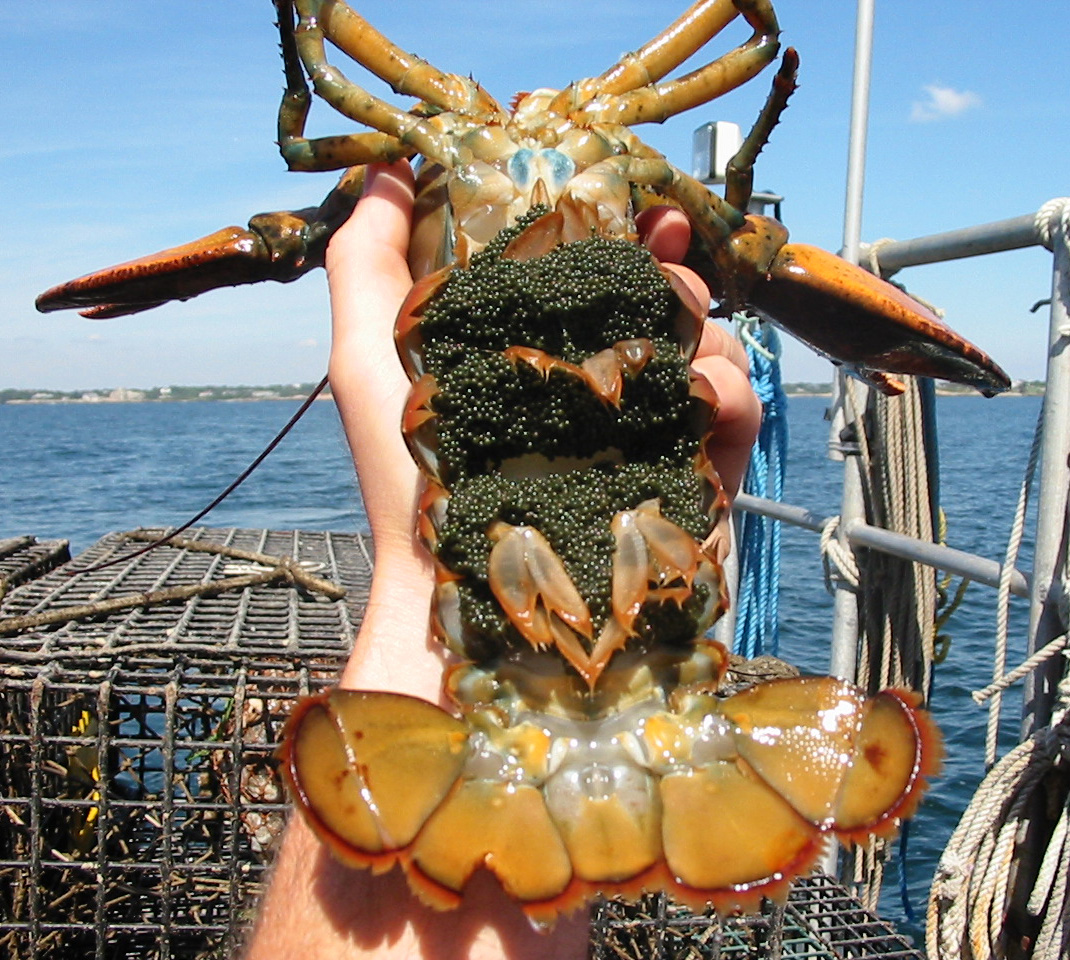
Protection is really important, because what the female does next makes her vulnerable. Lobsters are protected by their hard outer shell, but in the female, this outer shell also carries a pouch with the sperm of the last male she mated with. When preparing to mate again, she sheds this outer shell, and with it her previous mate's sperm. She then mates with her new partner, and she will carry his sperm with her to fertilize the eggs that she will carry and protect in her tale. However, until her new shell hardens, she is particularly vulnerable, thus needs the burrow and protection of her current mate. Once their affair is over, the female moves out to live her life with her eggs safely stashed to her tale, and another female will come to the male's burrow, advertising her intentions with more pee.

Will you ever be able to picture Ross as Rachel's lobster ever again?


Unfortunately the success of this delightful little dance is threatened in the waters of New England. In 1998, lobsters were found with ugly lesions on their shells, a disease that has since been named Epizootic Shell Disease (ESD). The disease spread from Long Island Sound to southern Maine. While the it doesn't often kill lobsters, it makes them virtually unmarketable, leaving fishermen unable to sell their catches.

About 30% of lobsters in the Narragansett Bay have the disease, but female lobsters are some of the greatest sufferers. They get the disease more frequently, and this is bad for baby lobsters. If a female lobster's shell is too far decayed from shell disease, she may shed her outer shell, and with it, all the eggs she was carrying on her tale. That is days of peeing and stroking and wooing down the drain; that batch of eggs will not contribute to the next generation of lobsters.

The cause and solution to shell disease is still being investigated by scientists, but what we do know is that when waters are warmer, there are higher rates of shell disease. This could be for a number of reasons. Lobsters don't do well in water that is too warm; hot water actually stresses lobsters' immune systems and makes it easier for them to get sick. Another reason is that warmer waters may mean that the cause of the disease, perhaps a bacteria, grows and survives better, meaning lobsters come in contact with the disease more. Either way, warmer waters are not good for lobster eggs.

Sometimes as a student of ecology, it feels like every phenomenon I study comes back to climate change. Sometimes I want the whole thing to be about something else, some other phenomenon, a different, smaller, easier problem. But the truth is I love this animal. I love the memories I have of it in my childhood, when my family would get together and buy a couple of lobsters for dinner when we were camping. I love their independence. I love the way the baby lobsters in my lab defy me and escape from their tanks into a mussel bed only to try to escape again when I capture them. I love that when I think of the New England coast, the first thing I think of is lobster. Weirdly enough, most of all I love their bizarre sex lives.


So here I go again, because I love lobsters. According to NOAA, 2017 was the third warmest year on record globally, surpassed only by 2015 and 2016. That's bad news for lobsters. If you are looking for a way to help the ocean, one of the best ways you can have the most widespread impact is taking climate change seriously. If you aren't sure what all the buzz is about, check out my previous article about carbon emissions. Support policies which consider the environment, and support scientists who are trying to figure out what is going on. Take public transportation or carpool if possible, and if your city has the opportunity to improve its own system (a lot of them need it), support it. Wear a sweater and turn the thermostat in your house down a few degrees. Consider having a few meatless meals a week, since creating and transporting this meat to you ends up emitting a lot of carbon. These are small steps that you can take on a daily basis to help.

For me, taking pride in my home means taking care of my state. Do it for the lobsters, and do it for New England.

Thursday, April 13, 2017

When color bleeds to white - Bleaching coral reefs

I'm moving, tousled, weightless, my hair streaming in front of my eyes as I try desperately to stabilize myself by lightly swishing my hands, keeping my legs completely still. Hand flapping is a movement that comes naturally to me; I've seen the home videos from childhood of an excited bald child waving her hands around in a flurry of activity. This time, however, I'm not simply excited. I'm also kind of wary, because I'm staring at a fiery red branch of coral, and the ocean waves are pushing me ever closer and closer to this bizarre animal that, if I touch it, will burn like fire for the rest of the day. I would kick my legs, but I would crush the unassuming coral beneath me. I'll find out later while I was dodging the infamous fire coral that one of my friends, enamored with a feather duster worm, ended up waving her hand inches from the nose of a nurse shark she didn't even see hiding beneath the reef. Nurse sharks aren't aggressive, but it just goes to show there is always more going on in a reef than you know.
When I think back on my days swimming in Belize, I am constantly pulled between wonder and anxiety. It's anxiety for how close I came to slamming into the delicate animals I was trying to observe, anxiety over the number of dead corals I saw, pale white brain corals wedged between red fire corals or more demure greens, and especially anxiety over the future. While through my eyes seeing the reef for the first time was magical, all I had to do was glance at my professor's faces when they didn't know I was looking, their eyes turned down, and hear them whisper, "It's changed." The reef was not doing as well as in past years. It was evident to anyone who had already been there or had eyes keen enough to see the coral skeletons left over, covered in algae, that the reef was not thriving as it once had. I resolved then that I would one day seek out what had evaded me: a magnificent specimen of coral reefs. I would see the Great Barrier Reef. Little did I know that within a year, the Great Barrier Reef would experience one of its most severe bleaching events in history, followed by another that is underway as I write this. While the Great Barrier Reef is by far the most famous reef, its death throws heard around the world and described in a number of influential news sources, the Great Barrier Reef does not perish alone.
One of my favorite fish at the New England Aquarium. The mandarinfish lives in the living coral exhibit where it can frequently takes cover in the crevices as curious visitors search for this painted beauty.
There are a number of problems facing coral reefs today, including vibrio (a bacteria that causes disease), sedimentation, crown-of-thorns starfish, and even an overgrowth of algae, but what we see at work in the Great Barrier reef and in other areas is perhaps one of the most dramatic threats. In order to understand coral bleaching, you must first understand the structure of coral. There is an old-timey question old jokester uncle figures say, which goes, when presented with something new, "Is it an animal, vegetable, or mineral?" In the unique case of hard corals, the answer is all three. Coral is a small animal, shaped rather like a sea anemone. It's outside is fleshy and soft, vulnerable, but for the fact that it has the incredible ability of building a limestone protective skeleton around its delicate frame. When you look at a branch of coral, you are actually looking at something rather like an apartment building that many corals have built, each small porous hole in the limestone structure a separate apartment for each tiny organism. Once established, however, these organisms cannot stray far. They can open up and reach tiny finger-like structures outside of their limestone castles, searching for food particles that float close enough to fall into their grasp. This, however, does not satiate hungry corals. In addition, corals line their fleshy translucent tissues with cells of algae. As the algae are exposed to sunlight, they photosynthesize and make food for the hungry corals, providing most of the energy that the corals need. Without these algal helpers, corals eventually die. I first learned the name of these vital little algae in the aquarium, gaining countless hours of amusement watching children stumble over the name as I talked to them about coral in the kids corner. They are called zooxanthellae (zoo-zan-thel-ee).
The healthy colors of a coral reef, with butterflyfish
It is the seemingly irrational, self-mutilating action of expunging zooxanthellae that characterizes coral bleaching. Scientists, after countless hours of studying bleaching corals, know what causes bleaching, but have yet to explain what practical purpose the corals' banishing of the algae may serve. What is evident is that corals bleach when they get stressed. Corals, despite being covered in stone, are very delicate. They require just the right amount of sunlight, very particular temperatures, and clean water. When it gets too warm or too cold, or the sunlight is too direct, or there is pollution, the corals get stressed, becoming a fluorescent color, a warning of what is to come. Soon after, the coral spits the algae out of its body. Since the algae is what gives coral its color, the coral is left a ghostly, skeletal white, as if it has been doused in bleach. After expelling the algae, coral have a short time to take up new algae, but if the coral remains stressed, it will simply die, the only thing left the white limestone structure it built for protection. Reefs are sometimes capable of surviving bleaching events; A coral reef may be able to bounce back from a bleaching event after about a decade given the right conditions. If bleaching occurs too frequently, however, corals cannot regenerate. This is why, with two years of bleaching in a row, scientists are in mourning and obituaries for the Great Barrier Reef have been circling the internet.
A bleached coral in front, with healthy non-bleached corals behind
When a coral dies, it does not die alone. A coral reef is a thriving community. While the coral provides the structure, a number of animals build their homes out of what the coral has provided. Sea urchins graze on the algae that grows in the limestone, small fish hide in the crevices of coral to escape predators, some sharks swim around the outside of the reefs, other sharks hide beneath coral crevices, giant hermit crab scavenge along the sea floor, and sea anemones attach themselves to old coral skeletons while anemonefish start families in their tentacles. When a reef dies, it is the underwater equivalent of the death of a city. In short, it is a natural tragedy.
As the climate warms and weather patterns become more extreme, we have seen more coral bleaching, and pristine reefs are few and far between. While it is tempting to lament the destruction of one of the greatest natural wonders of the world, I'm not ready to give up on a future where immersing yourself in an ocean brings you to underwater communities you could hardly imagine. There are a number of things that we can do in this moment:
  • Climate change and warming are linked to carbon emissions. Do what you can to limit yours. If it's safe, ride your bike. Take public transportation. Carpool. Buy a fuel efficient car. Eat a few meatless meals. Limiting how much meat you eat has a significant impact on your carbon emissions.
  • Be careful what you put on your lawn. While you may live miles and miles from the coast, water running off from your lawn will mix with other water, underground or in rivers, and this water has a tendency to find its way to the ocean. Chemical fertilizers and pesticides are notorious for throwing the ocean out of balance, sometimes by causing large blooms of algae, other times by simply increasing pollution.
  • Spread the word about what is happening to the coral reefs. If you are lucky enough to get the opportunity, volunteer at a local aquarium or environmental organization. If you can, invest in organizations that are dedicated to protecting the reefs and investigating ways that we can help them survive.
  • If you get to travel someplace where you can see coral, make sure you are following local guidelines to keep coral safe. Kicking coral, stirring up bottom sediment with your flippers, and even wearing certain kinds of sunscreen, when multiplied over many tourists, can stress coral. Make sure that the hotels and restaurants you go to are making sustainable choices by reducing their pollution impacts and offering sustainable seafood.
  • Look at your elected officials' history of protecting environment and climate. Hold them accountable for the laws they support and the impact we are having on Earth. What we do in America doesn't just impact our country. The carbon emissions we have released have contributed to the warming that is killing the Great Barrier Reef. Understand that inaction in arresting climate change is the same as complicity in the destruction of one of the most beautiful and diverse ecosystems on the planet.
All hope is not lost. There are some resilient reefs that have shown less damage than other reefs. We know because of history that organisms are capable of adapting to a changing planet if given time. Meanwhile, all we can do as we attempt to reduce our carbon emissions is to limit the other stresses we put on reefs, like pollution and overfishing, in order to give them time to adjust. I, for one, hope that in the future, I will be able to once again submerge my face in sea water and see before me not the skeletons of once great underwater kingdoms, but a brilliant swirl of reds, yellows, and greens as nurse sharks lie like carpets under the tapestries of coral and curious fish swim to my goggles to stare at their own reflections, blissfully unaware of the fate they escaped.