Valentine's Day was yesterday, and love is in the air; or maybe just the excitement of all the red and pink wrapped chocolate that is being marked down in stores across the country, and for me that is pretty dang close. And while you may have found your particular Valentine's Day more or less satisfying, I truly believe there is no bad time to peer into the unique and entertaining sex lives of ocean animals. Today I bring to you one of my favorite: the elaborate courtship of the American Lobster.
Lobsters are not particular friendly animals. In fact, if you have ever heard
Phoebe on Friends tell her story about how lobsters mate for life, you have been sorely, blatantly lied to. Lobsters spend a good portion of their lives lurking in individual burrows, with both a front and back entrance, hiding from predators and leaving during the evening to scavenge for food, eating whatever they may find. They aren't particularly choosy, and if they are caught in a lobster trap with another lobster, sometimes one of them will eat the other. When a baby lobster died in my lab, I came in the next morning to find its tank-mate had eaten its eyes. Just the eyes. They all now have their own containers.

However, this gruff exterior does not mean lobsters don't get a little touchy-feely from time to time. When a female is keen to mate, she visits her chosen male's burrow for a number of days, squirting urine out of her head into his burrow to inform him of her intentions. While the male needs some convincing, after a number of days of smelling her fragrant pee wafting into his bachelor pad, he lets her come in. What follows is a lot of heavy-petting with antennae and legs moving across each other's bodies until the female is convinced the male will protect her.
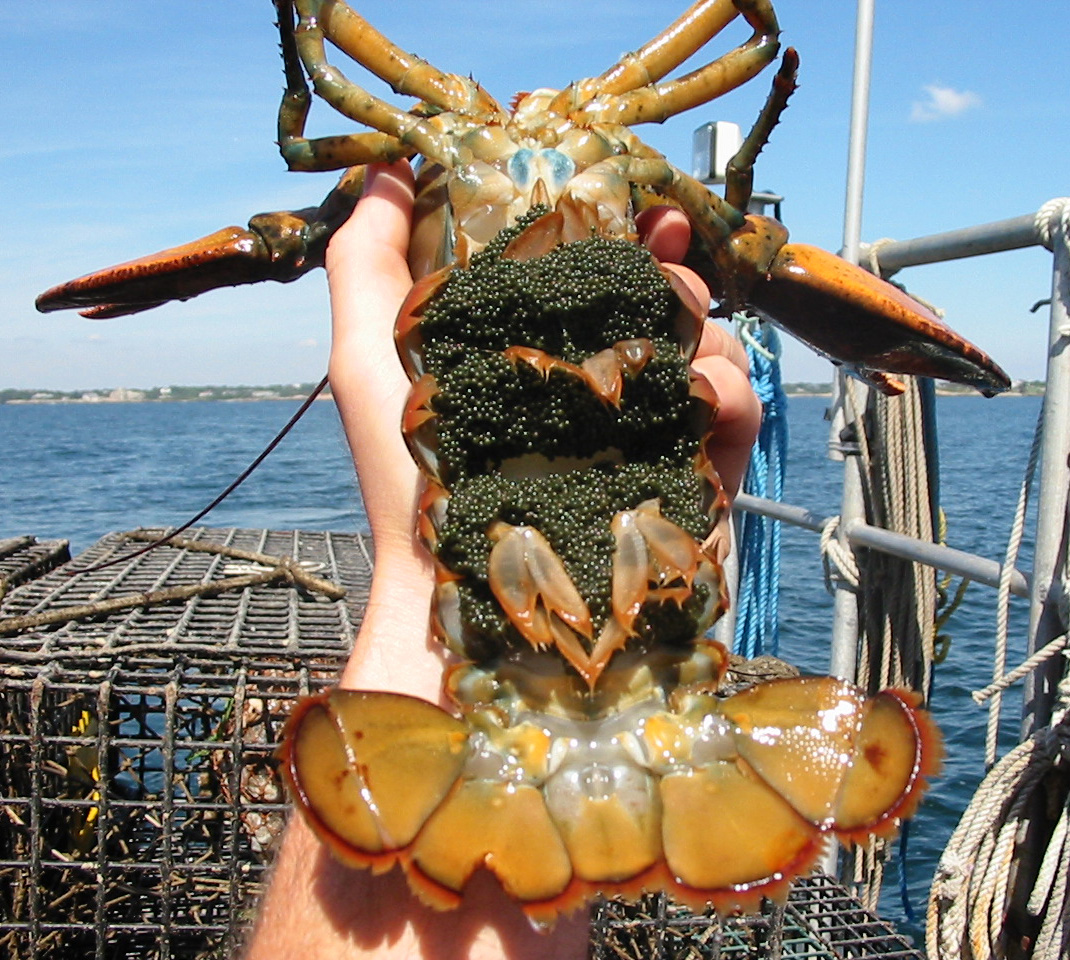
Protection is really important, because what the female does next makes her vulnerable. Lobsters are protected by their hard outer shell, but in the female, this outer shell also carries a pouch with the sperm of the last male she mated with. When preparing to mate again, she sheds this outer shell, and with it her previous mate's sperm. She then mates with her new partner, and she will carry his sperm with her to fertilize the eggs that she will carry and protect in her tale. However, until her new shell hardens, she is particularly vulnerable, thus needs the burrow and protection of her current mate. Once their affair is over, the female moves out to live her life with her eggs safely stashed to her tale, and another female will come to the male's burrow, advertising her intentions with more pee.
Will you ever be able to picture Ross as Rachel's lobster ever again?
Unfortunately the success of this delightful little dance is threatened in the waters of New England. In 1998, lobsters were found with ugly lesions on their shells, a disease that has since been named Epizootic Shell Disease (ESD). The disease spread from Long Island Sound to southern Maine. While the it doesn't often kill lobsters, it makes them virtually unmarketable, leaving fishermen unable to sell their catches.
About 30% of lobsters in the Narragansett Bay have the disease, but female lobsters are some of the greatest sufferers. They get the disease more frequently, and this is bad for baby lobsters. If a female lobster's shell is too far decayed from shell disease, she may shed her outer shell, and with it, all the eggs she was carrying on her tale. That is days of peeing and stroking and wooing down the drain; that batch of eggs will not contribute to the next generation of lobsters.
The cause and solution to shell disease is still being investigated by scientists, but what we do know is that when waters are warmer, there are higher rates of shell disease. This could be for a number of reasons. Lobsters don't do well in water that is too warm; hot water actually stresses lobsters' immune systems and makes it easier for them to get sick. Another reason is that warmer waters may mean that the cause of the disease, perhaps a bacteria, grows and survives better, meaning lobsters come in contact with the disease more. Either way, warmer waters are not good for lobster eggs.
Sometimes as a student of ecology, it feels like every phenomenon I study comes back to climate change. Sometimes I want the whole thing to be about something else, some other phenomenon, a different, smaller, easier problem. But the truth is I love this animal. I love the memories I have of it in my childhood, when my family would get together and buy a couple of lobsters for dinner when we were camping. I love their independence. I love the way the baby lobsters in my lab defy me and escape from their tanks into a mussel bed only to try to escape again when I capture them. I love that when I think of the New England coast, the first thing I think of is lobster. Weirdly enough, most of all I love their bizarre sex lives.
So here I go again, because I love lobsters. According to
NOAA, 2017 was the third warmest year on record globally, surpassed only by 2015 and 2016. That's bad news for lobsters. If you are looking for a way to help the ocean, one of the best ways you can have the most widespread impact is taking climate change seriously. If you aren't sure what all the buzz is about, check out my previous article about
carbon emissions. Support policies which consider the environment, and support scientists who are trying to figure out what is going on. Take public transportation or carpool if possible, and if your city has the opportunity to improve its own system (a lot of them need it), support it. Wear a sweater and turn the thermostat in your house down a few degrees. Consider having a few meatless meals a week, since creating and transporting this meat to you ends up emitting a lot of carbon. These are small steps that you can take on a daily basis to help.
For me, taking pride in my home means taking care of my state. Do it for the lobsters, and do it for New England.


.jpg)



_02.jpg)